
At the Elk River Natural Resources Conservation Area on the southwest Washington coast, a sprawling estuary of tidal flats and sloughs, salt marshes, and freshwater wetlands is sheltered by densely forested uplands. In these forests, tangles of roots slow the flow of runoff and trap sediment that would otherwise choke the waterways. Streams are kept shaded and cool and needles fall into the water to feed the aquatic food web.
Some of the trees are young, some older, some slender and some not in these second-growth forests. Yet here and there across the 5,143-acre site are remnants of a much older forest: massive tree stumps, wide enough at the base to fill a small room. These stumps were once Sitka spruce and western redcedar trees that presided over a complex forest ecosystem with multiple tree canopy layers, snags, thick layers of duff, and fallen trees fuzzy with moss and young seedlings sinking their roots into the softening wood.
Left to natural growth and disturbance and given enough time, these second-growth forests eventually will develop into a rich green world similar to the old growth of yesterday. But in 2013, the Washington State Department of Natural Resources’ (DNR) Natural Areas Program received an unexpected opportunity to speed up nature’s clock: a one-time, state legislative appropriation for restoration thinning.
“It was an opportunity to create a legacy for our grandchildren,” said Birdie Davenport, an environmental planner who was a natural areas manager for DNR’s Pacific Cascades region during the project.
With only two years to use the funding, the program worked with DNR foresters and silviculturalists to complete a challenging, unique forest restoration that showed what is possible through the power of collaboration.
The Starting Point
At various times, the upland forests at Elk River were home to logging camps, railroad grades, log stringer bridges, and corduroy roads (photo 1), which are roads made by placing split logs on the ground to help support a logging truck in a wet area. The roads and bridges and camps were here to support timber harvest, which began in the late 1800s.

Harvest in the early days meant big logs. Old growth. Eventually, all of it was harvested except a remnant here and there and a stand located in a hard-to-reach area between two branches of the Elk River. Harvest of second growth began around 1930.
Early clearcuts were left to regenerate on their own, usually with carpets of western hemlock and some Sitka spruce, western redcedar and Douglas fir that seeded from nearby stands. Later clearcuts were planted with Douglas fir. Most stands saw little in the way of stand management.
When DNR established the Elk River conservation area in the 1990s, it included these forests to act as a buffer for the estuary. Properties within the site boundary were then acquired as they became available. One acquisition was as recent as seven years ago.

Some of the forests on these properties were in good condition (Photo 2); for example, remnant old growth and healthy second growth up to 80 years old and older. Others were in poor to very poor condition. The latter included dense, doghair thickets of tall, thin trees (Photo 3). Many stands lacked the mix of trees one would expect in a coastal forest in Washington. Douglas fir should be scarce to absent, not abundant, and western redcedar and Sitka spruce should be common, not scarce. And being younger, many stands were structurally simple, with only one canopy layer and little in the way of snags or down wood.

The program began with removal of trash by the truckload and pulling of invasive plants such as English ivy and holly. One severely eroded area was planted with alder, nature’s therapy for depleted soils.
Yet the program was unsure what else to do with these forests. As a buffer for the estuary, they were functioning fine. As habitat, not so much. Some in the program preferred to let nature take its slow course: crowded stands would eventually self-thin through competition and other natural forces. Others were interested in moving conditions along more quickly through thinning for ecological objectives.
The goal of the project was to put second-growth forest stands in poor condition on the fast track to an older, structurally complex forest with better habitat.
In the end, the program decided to thin and began work on a forest restoration plan for Elk River and a program guidance document for thinning other forested, DNR-managed natural areas. The guidance document was vetted with a citizen’s advisory group, the Natural Heritage Advisory Council. As part of this work, the program visited the nearby Ellsworth Creek Preserve where The Nature Conservancy was doing similar work. They also began working with Bob Obedzinski, a retired US Forest Service silviculturalist who volunteered his time at Elk River to gather forest inventory data (for example, the size and species of trees).
However, it was not until State Representative Brian Blake obtained one-time funding from the Washington State Legislature that thinning went from concept to reality.
From that point, the clock started ticking.
The Challenge
The goal of the project (Map) was to put second-growth forest stands in poor condition on the fast track to an older, structurally complex forest that would provide better habitat and connect the dots between patches of older stands. The basic idea was to differentiate the structure of these stands: to bring light into the understory to encourage shrubs to grow, get a second forest canopy started, increase snags and down wood, and produce gaps of about a quarter acre similar to what might result from natural disturbance.
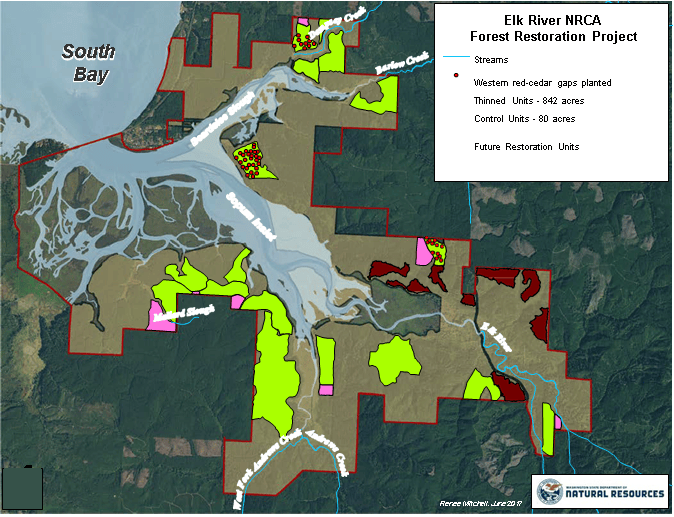
Another major objective was to increase the amount of western redcedar and Sitka spruce to more closely resemble the native forest. Most hardwood trees would be left to increase species diversity. Ideally, treated stands would be healthier and more resilient to natural disturbances and possibly climate change. Stands selected for thinning ranged in age from 5 years old to 30.
The program’s experience with thinning was limited: a 30-acre thinning in ponderosa pine and selective removal of trees from rare plant habitat. By contrast, the Elk River thinning involved two thinning contracts covering more than 800 acres under a tight deadline.
Although the program knew they needed help, they saw no reason to contract out for the planning phase when they had an entire team of foresters and silviculturalists right there on the region’s staff, plus access experts in forest inventory and other specialties at DNR’s headquarters in Olympia. All money for these services would come from the state legislative appropriation.
Region foresters and silviculturalists were accustomed to thinning, but this thinning was unique. Although it resembled a pre-commercial thinning, in that all cut trees would be left on site, it was not being done to grow the stand for eventual harvest. It was being done to restore a native ecosystem. That made it more complex. Also, DNR usually thins stands that are fairly uniform in condition. Not here.
“Walk 100 or 200 feet in any direction and forest conditions will be different,” explained Renee Mitchell, region natural areas manager and Elk River project manager. Multiple owners, multiple objectives and many years of harvest made this area a crazy patchquilt of conditions.
What made this thinning especially difficult was the wind. Coastal areas routinely see strong winds that can reach hurricane strength during periodic storms that roll off the Pacific Ocean
Brian Morris silvicultural scientist with the region, summed it up in a few words. “These thinnings did not fit the model of a GEM (general ecological management) thinning.”
What made this thinning especially difficult was the wind. Coastal areas routinely see strong winds that can reach hurricane strength during periodic storms that roll off the Pacific Ocean. Those winds are trouble for the shallow-rooted western hemlock and Douglas fir that dominated many of these areas. Plus in some of these stands, the tall, thin trees literally held each other up. Thin them, and the entire stand could fall in the next storm.
Birdie Davenport recalls visiting the site with DNR foresters and silviculturalists to generate ideas for thinning in the early phases of the project. In those crowded stands, “Some of them thought the only thing we could do was to start over.”
Added to these challenges were the logistics. This project involved people from two different parts of DNR working together on a major project for the first time, under a challenging schedule at a site located over 100 miles from the region office. “It was a huge challenge,” says Mitchell, “finding times when everyone could get out into the field together to look at stands.”
Mitchell, Carlo Abbruzzese (natural areas manager for southern areas of the region) and other program staff made the drive many times to help inspect the stands and collect inventory data. As did Morris and Keith Jones, former region marketing specialist. Morris and Jones were involved in the second of the two thinning contracts completed at Elk River.
On a typical day, Morris and Jones would make the long drive to get there—for Morris, that was 180 miles from home, one way—and then hike or drive for hours to look at the stands. “Hiking” is a generous term. “I would say it was more like crawling,” says Morris. Some trees were only shoulder width apart (Photo 4). One stand was so choked no one could enter it. Even so, they covered a lot of ground. “One unit (stand) was six miles just to get to it and walk through,” he recalls. Each stand was sized up for its potential and what it needed. Given the timeline, it was a triage approach. “If a stand seemed healthy, we jumped back in the truck and went to the next site.”

Once the thinning started, everyone did long days, including the contractors, Mitchell, Abbruzzese, and other program staff on point for contract compliance. “I was amazed at the willingness of those involved to give extra energy and time to the project to make it successful,” Mitchell remarked.
The Solution
The overall approach was not to start the stands over. It was to make best use of what was there.
A forester thinning a commercial stand for revenue may be thinking a few decades ahead to final harvest. Here, the team was thinking on a much grander scale: how the stand would look some 50 to 100 years or more in the future.
Good trees in overstocked stands needed to be “released” from competition so they had a chance to thrive. Ideally, good trees would be over 8 inches in diameter and preferably Sitka spruce or western redcedar. However, the best tree in a stand could be a Douglas fir or even the relatively short-lived alder. “An alder may not be a preferred leave tree. But with the tree spacing requirements we put in the contracts, sometimes that was what we were left with,” explained Jones. Which was not a bad thing; alder would contribute to the diversity of the forest while it lived and create a gap when it died. A large Douglas fir tree would provide habitat and later become a snag or down wood. Which brings up another unique aspect of this thinning: a forester thinning a commercial stand for revenue may be thinking a few decades ahead to final harvest. Here, the team was thinking on a much grander scale: how the stand would look some 50 to 100 years or more in the future.
In the gaps, they brought in the Washington Conservation Corps to plant 1,900 cedar seedlings. Planting in a criss-crossed jumble of fallen trees was difficult, yet “those trees may protect the seedlings from the elk until they get established,” said Mitchell.
So how does one thin a young, dense stand on the windy Pacific Coast?
In some areas, the program thinned around single, dominant trees. In another, they applied what Jones and Morris described as the “donut hole” approach. First, they selected the best, largest, healthiest trees in the stand. Then they identified surrounding trees that would help support those large trees when the wind blew, and thinned a gap around them (Photo 5). The rest of the stand was left alone.

By the end of June 2015, 842 acres had been thinned in two thinning contracts. Would the thinning work? How will the forest respond? Time will tell. The team selected several unthinned areas to act as control sites. In the future, these sites will be visited and compared to the thinned stands to determine how well these treatments worked.
Looking Ahead
The work at Elk River will continue. Abbruzzese is preparing to portage what was learned about grants, thinning, and cross-program cooperation to the next phase of Elk River thinning and similar cooperative, ecological thinning projects at Bone River and Niawiakum River natural area preserves, and Ellsworth Creek conservation area. Work will be funded with a grant from the Washington Wildlife and Recreation Program.
In the meantime, the newly thinned stands at Elk River should continue to grow, in time to create the green, mossy forests of yesterday for future generations to enjoy.
About the Natural Areas Program
The natural areas program manages a statewide system of conservation lands, including natural area preserves and natural resources conservation areas. The program protects some of the best remaining examples of natural Washington, including native ecosystems, plants and animals―the “blueprints” of Washington’s natural history. In addition to contributing to region-wide biodiversity conservation, natural areas serve as baseline reference sites to guide the management and restoration of less pristine lands. The mission of the natural areas program is “Conserving Washington’s native species and ecosystems, today and for future generations.”
