

DNR’s latest Washington Timber Harvest reveals the impact of export demand on Washington’s timber economy. Released in February, the annual report (now in its 57th edition) breaks out timber harvest totals by county and species. Based on annual Department of Revenue tax data, the report shows that exports kept many logging operations and shipping ports busy, even as domestic home-building (the chief market for West Coast softwoods) continued to struggle.
The exports even affected timber sales from state trust lands. By law, unprocessed timber–raw logs–from state trust lands cannot be sold for export, but with more of the privately owned timber heading overseas, DNR has become an important supplier to local mills.
Here’s a glance at the new timber report by the numbers:
1902 — When publication of state Timber Harvest reports began. (DNR has copies going back to 1940 and online versions back to 1990.)
2.74 billion — Board feet of trees (Scribner log scale) harvested in Washington in 2010.
2.39 billion — Board feet of trees (Scribner) harvested in Western Washington in 2010 (87% of state total).
1.82 billion board feet — Amount of logs harvested from private lands (industrial forest and small forest landowners) in 2010 .
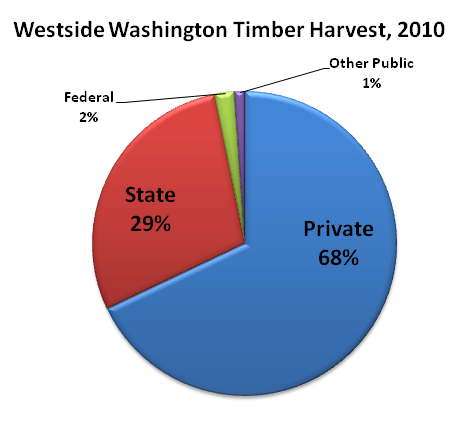
28 percent — Percentage of trees in state’s total harvest from DNR-managed state trust lands (all beneficiaries including counties) in 2010. In the western Washington counties where the majority of the timber was harvested, state trust lands accounted for 29 percent of the total.
The data for the Washington Timber Harvest Report came from statistics compiled by the state’s Department of Revenue which collects Forest Excise Tax. Since tribes don’t pay that tax harvest statistics from tribal lands were unavailable.
| Follow DNR on: |  |
 |
 |
 |
 |
 |
