
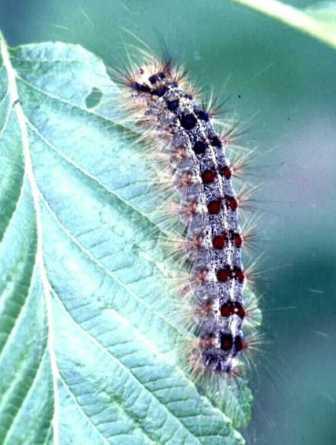
What would it be like to be in the midst of a forest caterpillar outbreak? Your senses are filled with the sounds of millions of caterpillars crunching leaves; the heat of sunlight descending through trees whose shading leaves have been consumed; the squeamish sight of tattered leaf remnants and branches covered with moving larvae; the smell of injured leaves and caterpillar poop; maybe even the sting of irritated skin or a rash from exposure to broken caterpillar hairs.
This is what people in Washington would regularly face if the gypsy moth were allowed to successfully establish populations and reproduce here. And when people couldn’t tolerate that discomfort, there’d be plenty of pesticides purchased and applied to control this menace on both public and private land.
Washington has enough trouble with periodic outbreaks of our native tent caterpillars, budworms, and tussock moths. We don’t need another pest, especially one with no natural enemies, a broad appetite for hundreds of species of trees and shrubs, and hairy larvae that cause skin rashes and respiratory problems in sensitive people.
Each year, the Washington State Department of Agriculture runs an efficient trapping program using colorful, paper triangle traps to catch and detect new introductions of gypsy moths in Washington State. The next few months are the time for them to safely and effectively eradicate populations of gypsy moth that were found last summer at two sites: Puyallup’s South Hill Mall and Eatonville. The numbers of moths observed in these areas indicate that it’s likely these populations will be able to persist and multiply.
The Department of Agriculture has successfully eradicated more than 80 infestations of gypsy moth in the past 38 years since the first gypsy moths were detected in Washington. This year, they will need to apply 3 to 5 treatments of the bacterial insecticide B.t.k. to approximately 56 total acres. Every consideration is being made to ensure local people are well-informed and that any safety concerns are addressed.
Please do your part to keep gypsy moths out of Washington by understanding this situation, supporting the proposed 2012 gypsy moth eradication treatments, and cooperating with continuing pest detection efforts that protect Washington.
As an advocate for healthy forests in Washington State, DNR is a determined, fervent, and enthusiastic supporter of the actions needed to safely and effectively eradicate gypsy moth.
For more information about this proposal or other invasive insect prevention programs, visit the Department of Agriculture’s website or phone them at 1-800-443-6684. The Department will hold open house meetings in February to describe the gypsy moth eradication project proposals to local residents and others who are intersted and answer any questions.
| Follow DNR on: |  |
 |
 |
 |
 |
 |
