
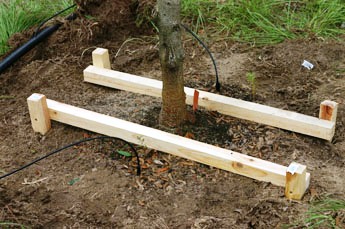
In a recent issue of DNR’s Tree Link newsletter, Ed Gilman, a professor in the University of Florida’s Department of Environmental Horticulture, says people sometimes stake their trees to death. Incorrect staking — especially staking too rigidly — can weaken a tree. As trees develop, swaying in the wind helps strengthen their trunks.
Overly tight staking or leaving ties to the stakes on too long prevent a tree from moving and developing trunk strength. If the ties are not removed after the first year, trees begin to grow around them. Those ties can become embedded in the tree and block the transport of water and nutrients taking place just below the bark. Overly tight ties will stress the tree and create a weakened point on the trunk where it becomes susceptible to breakage.
Save time and money by staking trees only if necessary. Container and bare root trees often require stakes to hold them firm. Trees with balled and burlapped roots have heavier root systems so they generally remain stable without staking. If you plant a bare root tree, consider staking it for a short period only. If trees must be staked, place the ties as low as possible on the trunk, no higher up than two-thirds of the tree’s height. The materials used to tie the tree to the stake should be flexible and allow for movement all the way down to the ground so that trunk taper develops correctly.
If you do stake trees, make sure to remove the suppport ties after the first growing season. Keep a close eye on it as it grows, and loosen the ties when needed. Sometimes stakes are left in the ground to deter vandalism or protect the tree from mower damage. If you need that extra protection, the straps should be significantly loosened or removed entirely.
For more information on innovative ways to stake trees, see more of Gilman’s suggestions.
| Follow DNR on: |  |
 |
 |
 |
 |
 |
