
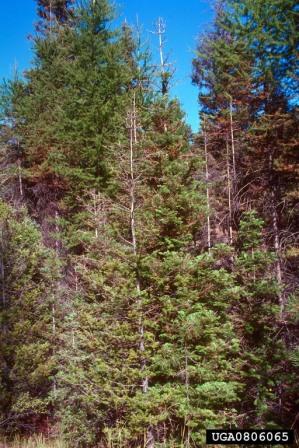
The western spruce budworm (Choristoneura occidentalis) is native, yes. But is it good? No! This destructive little critter has been eating new growth from Douglas-fir and grand fir trees in parts of Washington. You can easily see the damage if you drive over Blewett Pass (South of Leavenworth), but the outbreak is much broader — it stretches from Wenatchee to the Snoqualmie Summit.
The western spruce budworm is the larva of a rusty brown colored moth that is native to this area. It lies dormant in silk shelters through the winter and awakes in spring to crawl inside developing tree buds to feast on the growing needles, causing defoliation. It takes several consecutive years of defoliation before top kill (usually at three years) or mortality (usually at four or more years) occurs. The whole process results in damaged trees marked with drying, reddened, dead needles rather than healthy, new, green buds. This damage can be easily seen from the highway on Blewett Pass, but it is found a growing number of tree stands elsewhere.
The current state of poor forest health conditions has set up our forests to be vulnerable to disease, insects, and wildfire. A combination of over-crowded stands Douglas-fir trees and many years of extensive wildfire suppression has caused the poor health of some of our forests.
Forest health workshops offered
Workshops are available for private forest landowners to learn about forest health issues like western spruce budworm and how to assess the condition of their trees.
Mazama — September 24 — 9:00 a.m. – 3:30 p.m.
Tonasket — October 1 — 9:00 a.m. – 3:30 p.m.
Learn more at WSU Extension about registering for one of these workshops.
See where the outbreaks occurred during 2010 in DNR’s annual Forest Health Highlights report. You also can get advice and assistance from the DNR Forest Stewardship Program.
